
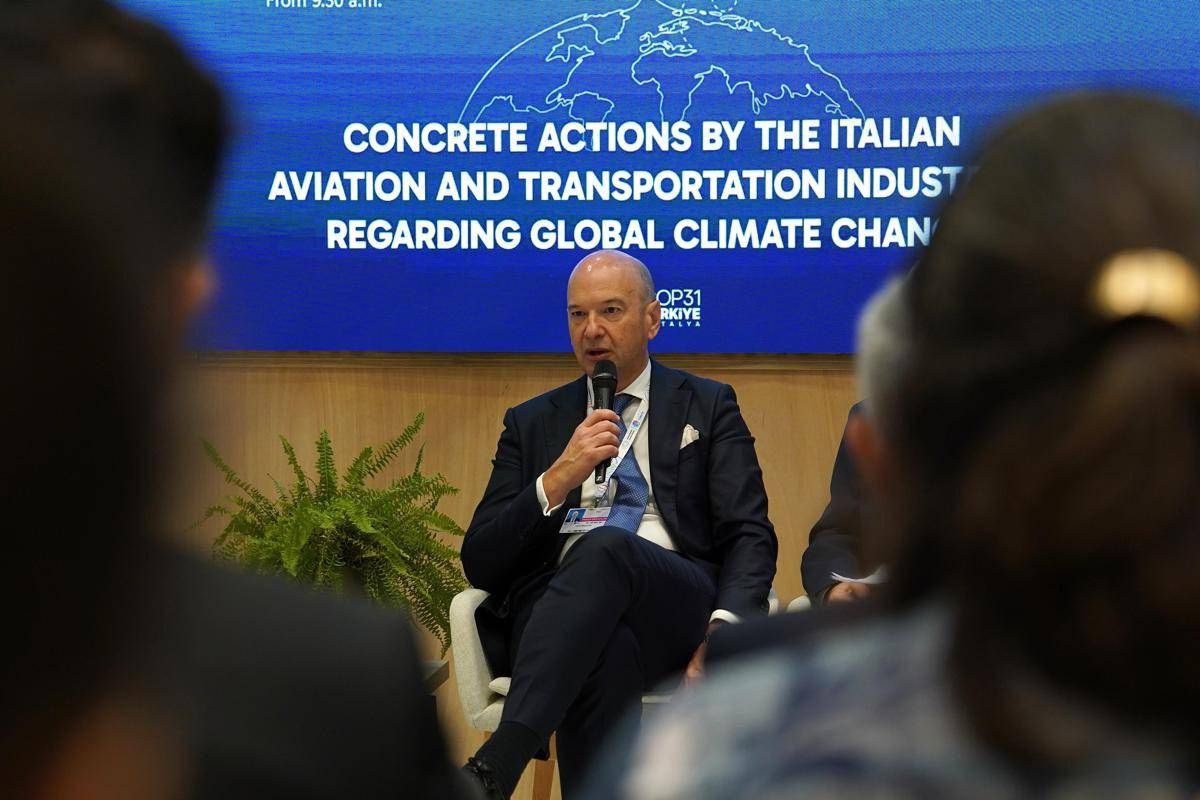
(Adnkronos) – Accelerating the decarbonization of air transport through the development of Sustainable Aviation Fuels (SAF), technological innovation, investments, and industrial policies capable of supporting the energy transition of the sector. These are the main themes addressed by Fondazione Pacta – Pact for the Decarbonization of Air Transport – during the event ‘Concrete actions by the Italian aviation and transportation industries regarding global climate change’, organized together with the Italian Air Force and Motus-E on the occasion of COP31, the United Nations Climate Change Conference, currently underway in Antalya, Turkey. The meeting, hosted at the Italian Pavilion, represented an opportunity for discussion on the contribution that the Italian system can make to support global emission reduction targets, with particular attention to the aviation and transport sectors. In particular, Fondazione Pacta, an entity that brings together 21 representative bodies from the entire air transport supply chain, promoted during the event the need to define a shared strategy for the decarbonization of air transport, identifying investment priorities, regulatory interventions, and the industrial conditions necessary to encourage the large-scale production and use of SAF. This path requires the involvement of the entire supply chain and combines the development of sustainable fuels with technological innovation and the improvement of operational efficiency. Marco Petracchini, President of Enilive and Board Member of Fondazione Pacta, spoke on these issues, elaborating on the role of sustainable fuels from renewable raw materials and the necessary conditions to support their production and dissemination: “Biofuels from renewable raw materials, such as SAF for aviation and HVO diesel for road and maritime transport, are already available solutions that can be used without the need to modify distribution infrastructures or vehicles. Enilive, also thanks to Eni’s commitment over more than a decade to the development of biorefining technologies, today produces and markets both SAF and HVO diesel on an industrial scale, which can make a significant contribution to reducing GHG emissions calculated along the supply chain, particularly for those sectors that are more difficult to decarbonize, such as aviation and marine,” declared Marco Petracchini, President of Enilive.
Another topic addressed by the Foundation concerned the role of airports as integrated hubs of energy and sustainable mobility. The electrification of ground operations, the development of charging infrastructures, the use of renewable sources, energy storage systems, and the strengthening of intermodality represent strategic areas to reduce the environmental impact of the airport system and promote greater integration between different transport modes. Ivan Bassato, Chief Aviation Officer of Aeroporti di Roma and Board Member of Fondazione Pacta, focused on the contribution of airport infrastructures to the energy transition. “The decarbonization of air transport requires an integrated approach, capable of combining technological innovation, investments, and industrial competitiveness. In this journey, airports can play a strategic role, evolving from simple transport infrastructures into true sustainable energy hubs. At Aeroporti di Roma, we are translating this vision into concrete projects, such as the Fiumicino Solar Farm, the innovative energy storage systems of the Pioneer project, and the progressive electrification of airport operations, with the goal of achieving Net Zero for Scope 1 and 2 emissions by 2030. However, the challenge of decarbonization goes far beyond the airport perimeter and requires intervention on emissions across the entire supply chain, particularly accelerating the development and dissemination of sustainable aviation fuels.” The economic sustainability of the transition and the need to encourage investments in the production of sustainable fuels represented another central element of the discussion. In particular, the challenge of making e-SAF production projects sustainable and financeable was explored, as they are still characterized by high costs, technological and regulatory uncertainties, and difficulties in defining long-term purchase agreements. Riccardo Dutto, Managing Director, Head of Infrastructure Industry, Global Corporate Department, IMI Corporate & Investment Banking Division – Intesa Sanpaolo Group, examined these aspects, illustrating the role of financial instruments and risk mitigation mechanisms, including contracts for difference and intermediation systems between producers and buyers, to encourage the mobilization of private capital and the development of the supply chain. “The large-scale dissemination of sustainable aviation fuels, and e-SAF in particular, requires creating the economic and financial conditions necessary to support investments for the development of the supply chain. Uncertainties related to technological and regulatory evolution, together with the need to align the long-term perspectives of producers with the needs of buyers, make it particularly important to identify solutions capable of promoting the bankability of projects. In this direction, innovative risk mitigation instruments, such as contracts for difference, and intermediation mechanisms capable of aggregating demand and ensuring greater predictability and stability of financial flows, can play a significant role.”
In a context of limited public resources, it will therefore be essential to encourage the mobilization of private capital through new public-private collaboration models, to accompany the transformation of decarbonization objectives into concrete industrial investments.” The discussion also highlighted the importance of an integrated approach to decarbonization policies, capable of combining environmental objectives with economic and industrial development, valuing the contribution of innovation, research, and collaboration between public and private entities. Professor Edoardo Croci, Sustainable Urban Regeneration Lab Director Professor of Practice at Bocconi University and member of Pacta’s Scientific Committee, spoke on these issues, addressing the role of policies and instruments necessary to accompany the sector’s transition path: “Airports are not just transit infrastructures: they can become true sustainability hubs, laboratories where replicable solutions for the ecological transition of territories can be experimented. From sustainable access mobility to the airport, to the energy efficiency of buildings, from the production of renewable energy to nature-based solutions, airports have the scale, expertise, and investment capacity to drive innovation. The decarbonization of air transport also happens on the ground: it is here that alliances between operators, cities, businesses, and research are built, necessary to achieve climate goals.” The initiative also delved, thanks to the contribution of the Italian Air Force, into research, development, and experimentation activities for sustainable aviation fuels and the role of atmospheric monitoring in understanding climate change. The discussion then extended, with the contribution of Motus-E, to strategies for accelerating mobility electrification, the development of charging infrastructures, and the integration of renewable energies. Participation in COP31 confirms Fondazione Pacta’s commitment to promoting an integrated vision of air transport decarbonization, capable of combining environmental sustainability, technological innovation, and industrial competitiveness. A path that requires close collaboration between institutions, businesses, sector operators, and the research world, to transform climate objectives into concrete and economically sustainable solutions.