
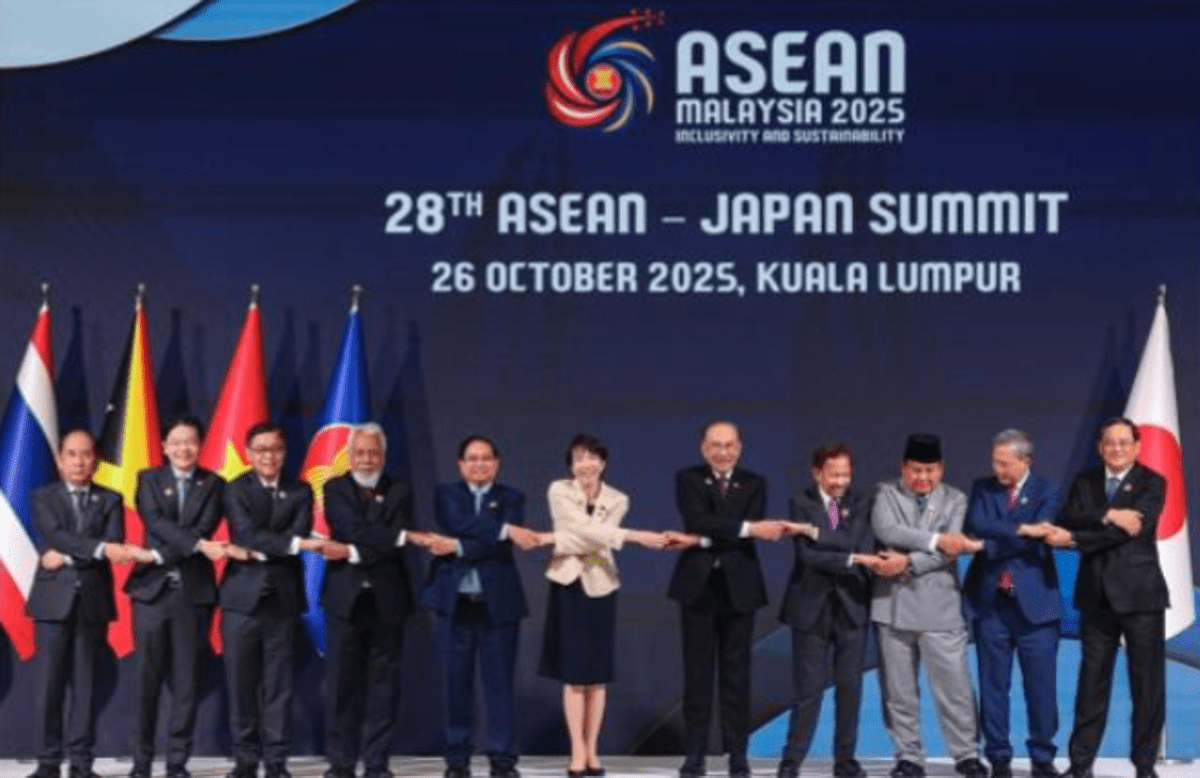
(Adnkronos) – “Congratulations on taking office as prime minister… you have managed to defeat some extraordinary men… My wife and daughters fully support you.” On October 26 in Kuala Lumpur, Malaysian Prime Minister Anwar Ibrahim, whose country chairs ASEAN this year, greeted the new leader of Japan with these words and a broad smile during the summit of the Association of Southeast Asian Nations (ASEAN). Premier Sanae Takaichi reciprocated with a smile: “Thank you. It is an honor to meet world leaders as Prime Minister of Japan.” Takaichi – Jiji Press reports – broke the glass ceiling by becoming the first woman to lead the Japanese government. Just six days after taking office, she made her diplomatic debut at the ASEAN summit, sometimes answering questions in English and attracting the attention of those present.
Thai Foreign Minister Sihasak Phuangketkeow said Takaichi seemed energetic and effective to him, noting that she showed genuine commitment in meetings with ASEAN members from the moment she took office. Malaysian Minister for Women, Family and Community Development, Nancy Shukri, also welcomed her rise, telling Japanese media that many people – especially women – had been waiting for this moment for a long time. She added that expectations are growing for progress in how the Japanese government addresses gender representation.
From the end of World War II until the years of strong economic growth in the 1970s, women in rural areas played a central role in the workforce, but in cities the idea that “men work and women stay at home” remained deeply rooted. For many young women, the typical path was this: finish high school, find a job as an “office lady” doing photocopying and making tea, then leave work once married or after the birth of a child. When the children were older, they could return to work part-time. This was widely considered the “normal” course of a woman’s life. It was common to hear girls say they hoped to get married by “Christmas” – meaning at 24 or 25 – and that reaching “New Year’s,” or 31, without being married would be a disaster. Women who wanted to continue working often faced pressure to resign after marriage or motherhood.
With greater awareness of their rights and the spread of dual-income families, more and more women have entered the workforce. The Equal Employment Opportunity Law came into effect in 1986, prohibiting dismissals based on marriage or maternity and making job advertisements reserved only for men illegal. In 1992, the Child Care Leave Law followed, allowing parents to take time off work until their child’s first birthday. In 1999, the Basic Law for a Gender-Equal Society mandated public institutions and companies to promote equality, and in 2016, the Law on Promoting Women’s Active Participation in Professional Life encouraged businesses to place more women in managerial roles. Gender-based job assignments have drastically decreased, and the term “office lady” has almost disappeared.
According to the Organization for Economic Cooperation and Development (OECD), in 2024, the employment rate for women aged 15 to 64 in Japan reached 74.2%, the highest among G7 countries and slightly higher than that of Germany (74.1%). This increase reflects not only higher education levels and greater legal protection, but also characteristics often considered typically Japanese: safe streets where women feel comfortable walking alone at night, reliable and punctual public transport that facilitates commuting, and a universal healthcare system that supports public health.
Yet, in the World Economic Forum’s Global Gender Gap Index 2025 – which assesses gender disparities worldwide – Japan ranked 118th out of 148 countries. Despite one of the highest female employment rates in the G7, Japan lags far behind in gender equality. The contrast with Southeast Asia is evident: the Philippines are in 20th place, Singapore 47th, Thailand 66th, Vietnam 74th, Laos 96th, Indonesia 97th, Cambodia 106th, Brunei 107th, and Malaysia 108th — all ahead of Japan.
The index measures gender gaps in four areas: economy, education, health, and politics. Wealthier countries tend to make greater progress in reducing these gaps. Japan is 66th in education and 50th in health, but drops to 112th for economic participation and 125th for political empowerment. It is precisely these weak results in politics and economics that drag down the country’s overall position.
In politics, the numbers are particularly low. Women represent only 15.7% of the House of Representatives, placing Japan near the bottom of international rankings. Only three of the 47 prefectural governors are women. The rise of Premier Takaichi – the first woman to lead the Japanese government – could mark an important turning point.
Economically, Japan continues to be criticized for the limited number of women in corporate leadership and the persistent gender pay gap. Even in large companies, executive meetings composed exclusively of men are still a frequent sight.
Yet some women in the business world have managed to emerge. One of the most well-known is Tomoko Namba, 63. Born in Niigata Prefecture, far from Tokyo, she grew up with a strict father who believed women did not need an education. With her mother’s support, she attended a women’s university in Tokyo. After graduating, she worked as a consultant at McKinsey & Company and later earned an MBA from Harvard Business School. In 1999, at 36, she founded DeNA Co., a mobile portal company. She transformed it into a large IT group and, in 2015, became the first woman to own a team in Japan’s 12-team professional baseball league. In 2021, she became the first woman to serve as vice president of the Japan Business Federation (Keidanren), the country’s leading business organization. Despite the many “firsts” associated with her name, Namba states that she never felt hindered in her work because she was a woman. Her simple and approachable manner has made her a role model for many women.
Another figure attracting attention is Mitsuko Tottori, 60, who became president of the flag carrier Japan Airlines (JAL) last April. Born in Fukuoka Prefecture, she graduated from a junior college in Nagasaki Prefecture and joined Toa Domestic Airlines in 1985 as a flight attendant. After the merger with JAL, she built her career primarily in cabin operations. While many JAL executives – mostly men – come from finance or corporate strategy, Tottori rose through the ranks thanks to her field experience, focus on service and safety, and leadership skills. She became the first former flight attendant – and the first woman – to lead the company. In a company where most presidents are graduates of the University of Tokyo, her educational path through a junior college also stands out. While celebrated as a pioneer, she states that she simply wants to lead the company her own way, remaining as practical and natural as possible.
With an increasing number of women entering leadership roles in the business world, the next challenge is to raise the baseline for all. If represented graphically, female labor market participation in Japan takes the form of an “M-curve”: it increases into their twenties, dips in their thirties during maternity and childcare years, then rises again in their forties. Interruptions for childbirth and childcare often compromise career advancement. Many women return to part-time jobs instead of their previous positions, resulting in lower wages. Keeping women in the workforce – and transforming the M-curve into a plateau – has become a crucial indicator of progress.
Japan also has much to learn from Southeast Asian countries that rank higher in the Global Gender Gap Index. In the Philippines – the best-positioned country in the region – women hold prominent roles in politics, business, law, and the corporate world. Coeducation and democratic institutions introduced under US rule before World War II laid the groundwork, and in 1986 Corazon Aquino became the first female head of state in Southeast Asia, helping to push forward gender equality policies. A family-centered culture also strengthens women’s participation in work: when women work outside the home, grandparents and siblings often help care for young children.
Singapore, with its small size and limited workforce, has long encouraged women to play active roles in both the economy and politics. Many companies offer flexible hours, allowing employees to adapt work to family responsibilities. In Thailand, women pursue higher education in high percentages. According to UNESCO data from 2024, the overall university enrollment rate is 45%, but the gender gap is notable: 52% for women versus 39% for men. Women now represent about 60% of university students. With increasing skills and specializations, a growing number of women are entering managerial and executive roles. Workplaces also tend to support work-life balance, offering benefits such as 30 days of paid sick leave per year.
In Japan, where nuclear families are common, parents often have little support from extended family. When local nurseries or kindergartens are full, securing a spot for a child can be difficult. Even when spots are available, childcare costs can exceed what one earns from a part-time job, pushing some women to stop working altogether. And when a child gets sick and a parent has to miss work or leave early, many women still feel pressured or unsupported in their workplaces. If Japan hopes to become a true leader in female workforce participation, it has much to learn from the policies adopted in Southeast Asia.
Sport offers a way to measure how freely women can participate in society. Before World War II, many in Japan considered women’s athletics “unseemly” or “unfeminine.” After the war, however, school sports clubs became a central part of education, offering girls the same opportunities as boys. Today, those efforts to broaden participation are reflected in the results of top Japanese female athletes. At the Paris 2024 Olympics, Japan won 45 medals – sixth in the medal table – with 23 in men’s events, 18 in women’s events, and four in mixed competitions. About half a century earlier, at the 1972 Munich Games, Japan had won 29 medals, only two of which were won by women. The sharp increase in women’s medals reflects the expansion of women’s roles in society. From politics to everyday workplaces, women deserve the chance to succeed on equal terms with men. Japan needs a society where every woman can shine in her own way.